Buyer Guidance & Clarifications
Frequently Asked Questions: Buying Indian Red Chilli
Authoritative answers to commercial, technical, and regulatory questions from international spice importers:
What types of red chillies does JM Masala export from India?
JM Masala exports three principal Indian red chilli varieties: commercial high-heat Teja Chilli (S17, 50,000–85,000 SHU), fiery small Bird's Eye Chilli (Kanthari, 100,000–225,000 SHU), and the world-renowned super-hot King Chilli (Bhut Jolokia / Ghost Pepper, 800,000–1,041,000+ SHU).
Where does JM Masala source its red chillies?
We source Teja chillies directly from the premier agricultural mandis of Guntur (Andhra Pradesh) and Warangal (Telangana), authentic Bird's Eye chillies from Kerala and Southern hill belts, and genuine King Chillies directly from contracted grower networks in Assam and Northeast India.
What is the difference between whole with stem and stemless chillies?
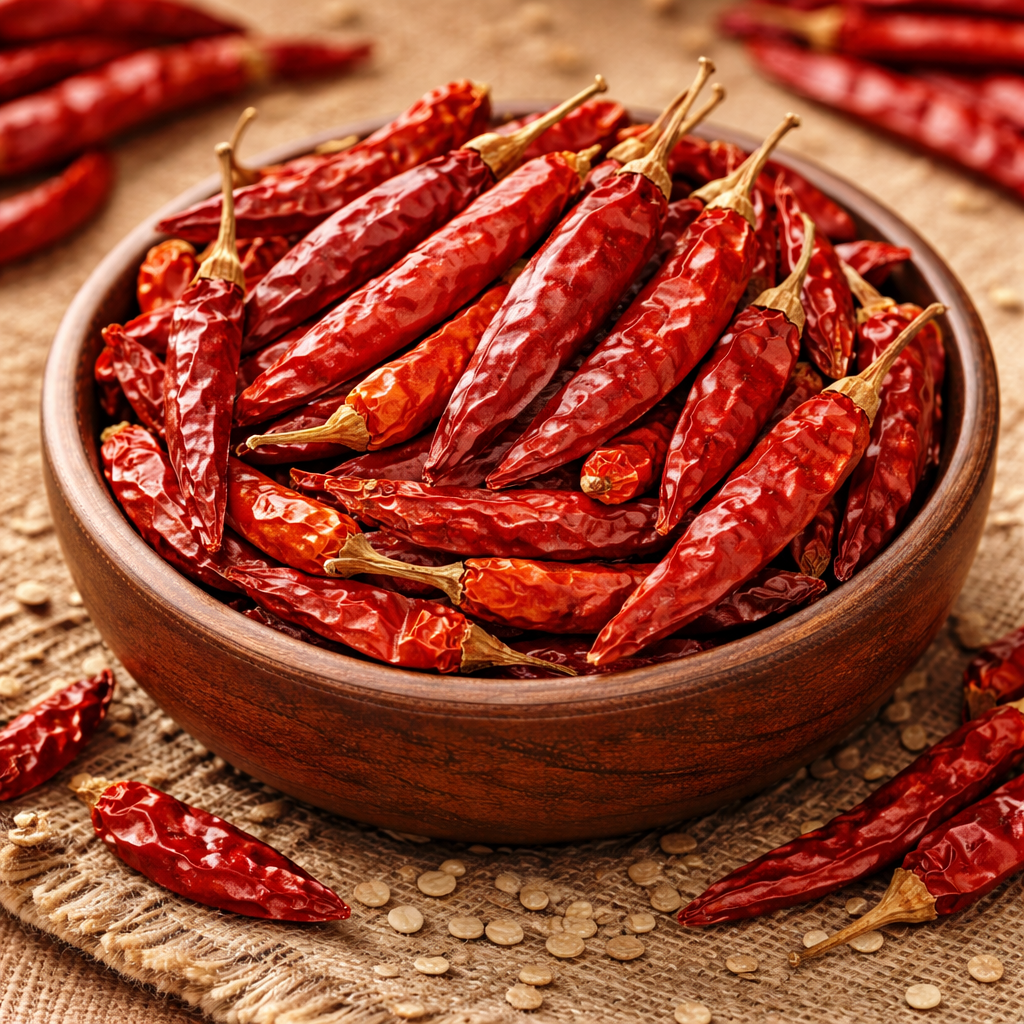
Whole with stem chillies retain the natural green/brown calyx and stalk. Stemless chillies have the stalk cleanly removed (either manually or mechanically). Stemless chillies reduce tare weight by approximately 5% to 7%, pack more densely into containers, and can be fed directly into commercial grinding or extraction mills without stem bitterness.
What is the Scoville Heat Unit (SHU) rating of your chillies?
Our chillies cover an extensive heat spectrum calibrated by HPLC: Teja Chilli ranges between 50,000 and 85,000+ SHU; Bird's Eye Chilli delivers 100,000 to 225,000+ SHU; and King Chilli (Bhut Jolokia) reaches extreme levels of 800,000 to 1,041,000+ SHU.
What ASTA color values are available?
ASTA color ranges from 50 to 70 ASTA for high-pungency Teja chillies, up to 90 ASTA for selected Bird's Eye batches, and 50 to 80 ASTA for solar-dried King Chilli. If buyers specifically require high color with low heat, we also supply Byadgi-style red chillies with 120–150+ ASTA upon request.
Can JM Masala supply Aflatoxin and Sudan Dye test reports?
Yes. Every export shipment can be accompanied by an accredited NABL third-party laboratory Certificate of Analysis (COA) confirming that Aflatoxin B1 and Total Aflatoxins meet EU limits (<5 ppb B1, <10 ppb Total) or US FDA limits (<20 ppb Total), and that Sudan Dyes (I, II, III, IV) are absent/negative.
What are the standard packaging options for export?
We supply red chillies in 10 kg, 20 kg, and 25 kg new PP woven bags with polyethylene liners, traditional jute sacks, corrugated cartons (specifically recommended for stemless and King chillies to prevent pod breakage), and hydraulic pressed bales up to 50 kg for high-tonnage ocean shipping.
How many metric tons of red chilli fit in a 20ft or 40ft container?
Because whole dried chillies have low bulk density, standard bag packing yields approximately 6.5 to 7.5 Metric Tons in a 20ft FCL and 14.0 to 16.0 Metric Tons in a 40ft HC. When using hydraulic pressed bulk bales, container capacity increases substantially to ~11.0 MT in a 20ft FCL and ~22.0 to 24.0 MT in a 40ft HC.
Does JM Masala supply crushed chilli flakes and chilli powder?
Yes. We supply coarse crushed chilli flakes (with customized seed ratios or 100% deseeded flakes for pizza toppings) and micro-pulverized pure red chilli powder ground on cold hammer mills to preserve volatile capsaicin oils and avoid scorching.
Can international buyers request samples before placing a contract?
Yes. We dispatch representative export samples (whole pods, stemless, or powder) via international air courier along with preliminary specification sheets and laboratory test reports for buyer evaluation.
What export documentation is included with each consignment?
Consignments include a Phytosanitary Certificate from the Plant Quarantine Organization of India, Certificate of Origin (COO), NABL Lab Certificate of Analysis (COA), Fumigation Certificate, Commercial Invoice, Packing List, and Bill of Lading (BL).
How can I request a quotation for bulk Indian red chilli?
Submit an inquiry via our contact form or contact our export desk on WhatsApp (+91 91067 66041) stating your required variety (Teja, Bird's Eye, or King Chilli), format (whole, stemless, crushed, powder), heat/color parameters, packaging format, and destination seaport (FOB Mundra/Nhava Sheva or CIF global ports).